Know what your council will say, before you start spending
Every extension, loft conversion and garden room in England leaves a public record: what was proposed, what the council decided, and why. Planiverse reads the record around your address (more than a million council decisions across every major English planning authority) and turns it into a report you can act on.
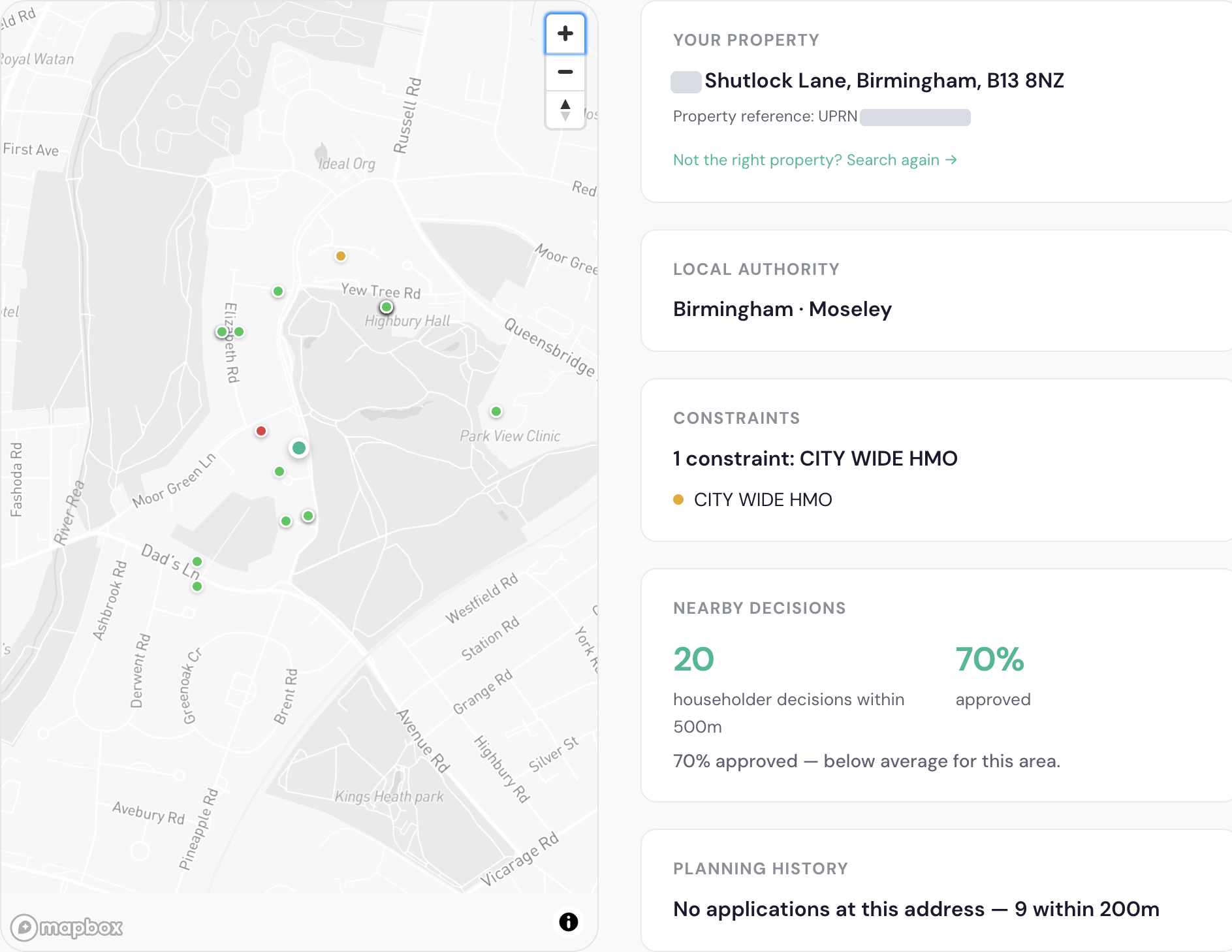
Type your address. In under a minute you'll see your property's constraints, what's been approved and refused near you, and whether your project is likely to need permission at all.
We couldn't find that address. Try entering your full postcode.
£19 during beta. PDF by email, typically within 5 minutes. Refund if it's not useful. Every claim links to the council's own record.
Currently covering England only. Wales, Scotland and Northern Ireland coming soon. For updates, email hello@planiverse.uk.

Real figures: approval rates for these project types in Gloucester over the last three years, from Gloucester City Council's published decisions, updated weekly. Your report links every figure to the council's original record.
You could find all this yourself. Here's what that looks like.
Your property's planning picture is public, but it's scattered across systems that were never designed to be read together:
Your council's planning portal for every nearby application, searched one at a time, with decision notices in PDF scans. The national planning constraints dataset for conservation areas, Article 4 directions and listed buildings (if your council has uploaded theirs). The Environment Agency for flood zones. Historic England for listings. The GPDO legislation itself for whether your project needs permission at all: 40+ pages, with different rules for terraces, conservation areas and flats.
Most people who try give up after an hour with half the picture. The report does the same job in minutes, and shows its working: every claim links back to the council's own record, so you can check any of it yourself.
Why £19 is the cheapest part of your project
An initial opinion from a planning professional (a town planner, architect or heritage consultant) can easily exceed £1,000, and before anything is submitted, even that opinion comes heavily caveated. A typical householder application costs £2,000–£4,000 in drawings and around three months before the council says anything substantive.
This report gives you the facts that professional opinion starts from: your property's confirmed constraints, and the real approval-and-refusal record on streets like yours. For £19, before you've spent anything else.
The homeowners who get clean approvals aren't lucky. They walk in already knowing.
Your Property Planning Report
A PDF you can read on your phone in 10 minutes, or hand to your architect.
-
Do you even need permission? A clear answer for your specific property, taking into account conservation areas, listed building status, Article 4 directions, and other constraints that limit Permitted Development rights.
-
What gets approved on streets like yours. Real recent decisions within 500m of your property, not generic statistics.
-
Why applications get refused around here. The specific reasons your council has refused similar projects, so your design can avoid them.
-
The constraints that affect your property. Flood zones, conservation areas, TPOs, listed buildings, Article 4 directions, ancient woodland and the rest, checked against the planning datasets your council uses.
-
What to do next. Whether to go straight to a planning application, book pre-application advice first, or rethink the project entirely, with the actual fees for your specific council.
Every claim in your report links back to a real council decision, so you can check the data for yourself.
And where the data can't confirm something, the report says so. If a constraint is unconfirmed in the national dataset, your report reads “unknown: check with your council”. It never guesses, and never dresses a gap up as a green light.
Walk in already knowing
How it changes the architect conversation
Most homeowners turn up to their first architect meeting with a vague brief and let the architect shape everything: the scale, the design language, what to push for, what to play safe on. The result is often a scheme that costs more than it needed to, or one the council pushes back on because nobody asked what had already been approved nearby.
Spend £19 first. Walk into that meeting with a list of comparable projects approved within 500m, the specific refusal patterns your council has shown, the constraints that limit what's actually possible on your plot, and a sense of whether your council's pre-application advice is worth the fee.
You'll get a better scheme, faster, with fewer revisions. The £19 pays for itself before the architect's first invoice.